Showing posts with label Meg Stentz. Show all posts

Sunday, March 7, 2010

Modernism


“Modernity is a qualitative, not a chronological, category. Just as it cannot be reduced to abstract form, with equal necessity it must turn its back on conventional surface coherence, the appearance of harmony, the order corroborated merely by replication.”

-Theodor Adorno, philosopher and composer

“Make it new!”

-Ezra Pound, writer

(If you heard this quipped in Tim Gunn’s voice, don’t judge yourself: it’s only natural.)


In the world of visual art the focus shifted away from replicating the appearance of the world to replicating its essence. Thus, color and shape, and their arrangement became the focus.

Modernism in literature was most focused between the years 1915 and 1945, in visual art the period lasted much longer. It was a reaction to the changing world, which was becoming more industrial and efficient--a world in which the assembly line reigned and the average worker was distanced from his final product.

Modernism played a lot with form.

In literature think: Virginia Woolf’s “tunneling technique”, Jose Villa’s excessive use of commas/his visiting and re-visiting of the same ideas, Bruce Nungent’s play with ellipses.

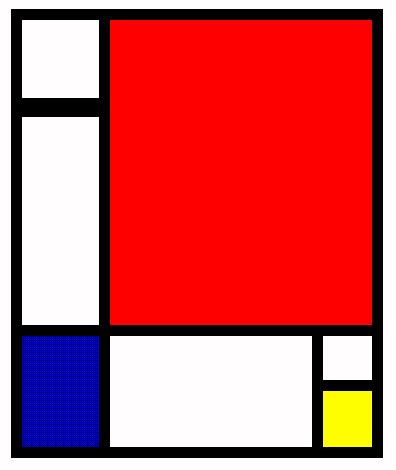
In visual art think: Pablo Picasso’s cubism, Salvador Dali’s surrealism, Piet Mondrian’s play with color and shape


In his essay Avant-Garde and Kitsch art critic Clement Greenberg rejected consumer culture, labling it “kitsch”. He saw modernism as a counter-movement against the forces of popular culture, and ultimately, capitalism. He argued that the avant-garde movement came about to reclaim the aesthetic value of art, which was being eliminated for the sake dumbing-down of art in an attempt to make it more accessible to the masses.

*http://en.wikipedia.org/wiki/Modernism

Exploring Michel Foucault: A Wikipedia Search

Search: Michael Foucault

Did you mean? Michel Foucault

Yes. Click.

http://en.wikipedia.org/wiki/Michel_Foucault

Heading: Madness and Civilization

Surface Level: This was Foucault’s first book. It focuses on madness/treatment of the mad.

Deeper: He notes transformation of ‘madness’ into ‘mental illness’. Semantics are everything. He argues that though this seems like a big shift, the treatment for mental illness at the time was cruel.

Heading: The Birth of the Clinic

Surface Level: Foucault’s next book, it looks at the medicine and teaching hospitals.

Deeper: Again, Foucault zooms in on discourse. He talks about “regard (translated by Alan Sheridan as ‘medical gaze’)”. Normally this medical gaze is limited to medical facilities, but Foucault asserts that it’s spread and effects the population at large. Clinical discourse created paradigms that defined populations. (Think: Stephen Gordon in Radclyffe Hall’s Well of Loneliness. Medical discourse clearly affected and dominated her perception of herself. Immediately she identified with this clinical text, and it became a part of her identity.)

Heading: Death and The Labryinth

Surface Level: Foucault’s book about the literature of Raymond Roussel, an experimental writer.

Heading: The Order of Things

Surface Level: Foucault asserts that conditions of society determine its discourses about what is acceptable, and that these conditions and there fore discourses and norms change. The book begins with a discussion of Diego Velazquez’s painting Las Meninas. He describes in detail the painter’s “complex arrangement of sight-lines, hiddenness and appearance.”

Deeper: Presumably the painting serves as a metaphor for society’s layers and “sight-lines” which determine discourse and what is socially acceptable. Thinking about painting/art as a metaphor for language can be helpful also in thinking about change. It’s much more apparent how graphic art has changed than the more subtle changes that language has undergone, but it is these changes that govern. (An example of medical discourse governing the population: the DSM denoted homosexuals as “sick” until 1973. Much like transsexuals today, who have to accept diagnoses of gender dysphoria, accept that they’re “sick” or “abnormal” before they’re allowed to have a surgery to reconcile their physical bodies with their gender identities.)

Heading: The Archaeology of Knowledge

Surface Level (which is, in this case, very deep): The truth and meaning of language is derived not just from words, but from how those words fit into larger discourses. “Statements constitute a network of rules establishing what is meaningful, and these rules are the preconditions for propositions, utterances, or speech acts to have meaning.” In other words, unlike structuralists, Faucault thinks that words create disourse which allows for meaning and truth--words have to be understood within the context of a certain time period/social era. (Conversely, structuralists think meaning comes from strict semantics.)

Heading: Discipline and Punish

Surface Level: Foucault looks at modes of punishment and asserts that “visibility is a trap” through which society exercises its control over individuals. He famously, talks about Jeremy Bentham’s “Panopticon” and his own idea of “power-knowledge”. Power-knowledge, significantly links the concepts of power (of the institution) to knowledge (about the individual), which is achieved through visibility/surveillance via government workers like police and teachers.

Heading: The History of Sexuality

Surface Level: Book one attacks the repressive hypothesis: says instead that people were “incited to discourse.” The second two books talk about sex in ancient Greece and Rome.
What if Tom Jenks, editor of Garden of Eden had sat in on our class today? An Imaginary Letter....

Dear Professor Moddelmog,

As I understand it, this text was meant to center around these unspoken but binding forces: power, sexuality, gender. Catherine provides the vehicle through which a counter-discourse to patriarchal convention can be introduced. And I must say I was struck by her character: clearly she was meant to be the focus here, and I made great cuts to make that apparent to the reader. My revisions have brought her and everything she embodies to the forefront of the text. Never before has a Hemingway woman fought so fiercely against all the binary expectations of society: Catherine refuses to be singularly, visibly, white; heterosexual; a woman and all that entails (fragile, predictable, safe). She is more than all of these things: she is fluid between rigid social categories. My favorite day dream has become one in which I picture her, lying dark on the beach, drawing a fine line in the sand with her big toe (which surely is elegant but unpolished) and watching as a wave washes away this symbolic confinement. Because, Catherine is that wave: a force that is at once powerful and destructive as well as inventive and beautiful.

Catherine defies typical gender roles, sexual roles, and power roles. In my journey through the manuscript I was sure this defiance was the message I was meant to unlock for the reader. Unlock it I did, by cutting away unnecessary and unfinished sub-plots and distractions. I arrived at this decision, confident, because as I was reading I felt as though Hemingway was guiding me by way of a motif surrounding the tension between what is public and what is private.

Catherine, who I knew to be the focus, struggles with this tension throughout the text. David, whom I identify with Hemingway because he is a writer, oppresses her as she fights to decompartmentalize their lives by reconciling the private lives she’s created for them with the public life that David leads as a public figure. I believe that I am meant to do Catherine’s work and provide the public with a book that reveals the private life and thoughts of Hemingway.

Early on, this dialogue between David and Catherine struck me,

“I have these flashes of intuition,” he said. “I’m the inventive type.”

“I’m the destructive type,” she said. “And I’m going to destroy you. They’ll put a plaque up on the wall of the building outside the room.” (5)

David, the first speaker, represents the conventions of patriarchal society, and Catherine, its demise (read: boy’s hair cut, sodomy, gender-reversal). I felt this book is to be the plaque on the wall. It declares that the conventions of both society and the expectations for Hemingway’s work have in fact, if only temporarily, been destroyed. Though I concede that it may be absurd to contend that Hemingway meant for this passage to be read as a sort of hint at the conceit (that The Garden of Eden is the destruction of his literary convention), which he would carry out for hundreds of pages more, I am positive that it was bound to speak to me in just the way it has: as a voice, from the grave, urging me to unlock the most dangerous aspects of this work and, as it were, nail the plaque to the wall. And the plaque might say: what is normative is merely a line drawn in the sand. Catherine’s actions in the novel show this, and now that I have revised it, The Garden of Eden shows that what was once considered “normal” for Hemingway can change as well: Social constructions can be dismantled, and the private can come into the public.

I hope that through this brief letter you’ve come to understand the text a little better, and appreciate my efforts a little more.

Sincerely Yours,
Tom Jenks